Tag Archives: An Evil Eye

Yashim’s fantastic chefs!

A few days ago I sent out a call for people who might enjoy testing the recipes for Yashim’s Istanbul Cook Book. Are the instructions clear? Is the result scrumptious? Are you transported by a touch of heat and cumin seed to the shores of the Bosphorus?
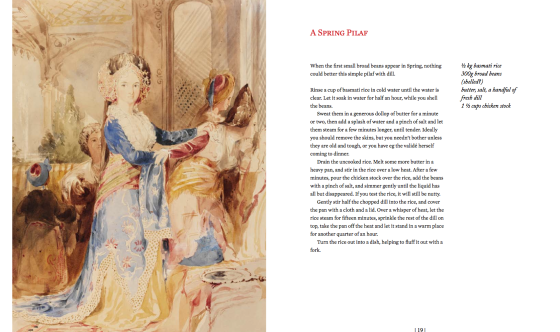
A page from Yashim's Istanbul Cook Book
A page from Yashim’s Istanbul Cook Book

The response has been fabulous – I’m incredibly grateful to everyone who got in touch at [email protected]. People are road-testing these Ottoman dishes all over the world, from Pakistan to Wisconsin, Estonia to Washington DC (hello to the Culinary Historians of Washington: CHoW!), which makes it a lovely peaceful international effort. To all those who have been in touch, a big thank you for taking part.

I’ve asked Jillian’s permission to include this great photo of a soup – she was the first to send it in. Great saucepan (and I like the book getting a light grilling, too)!

Widow Matalya's Chicken Soup - with a pleasantly battered copy of Yashim's fourth adventure!
Widow Matalya’s Chicken Soup – with a pleasantly battered copy of Yashim’s fourth adventure!

As far as I know, there are no representatives of the southern hemisphere involved yet – but I have a number of recipes yet to check over, so if there are any Aussies out there, give us a shout! And do pass the email [email protected] around to your friends if they fancy getting a recipe to try: I’m not planning to close the hatch until Wednesday evening, February 4th.

Peasant bread - made with a traditional chickpea starter

Peasant bread – made with a traditional chickpea starter

You might like to know this, taken from the introduction to Yashim’s Istanbul Cook Book:

Most of the ingredients need no further introduction but there are a few spices which may be worth tracking down online or at a likely grocery shop.

I use two kinds of chilli pepper. Pul biber is hot chilli, in flakes or powder – like paprika or cayenne, the more you add the hotter the dish. Isot, or Urfa, biber, is a more subtle creature, darker in colour, made from Urfa red peppers that darken as they grow to deep purple. They are dried in the sun by day and wrapped up at night, the better to concentrate their flavour, which is slightly smoky, slightly sweet, and deliciously warm.

In the Spice Market and elsewhere you want to buy pepper in dry rustling flakes – vendors sometimes add salt and oil to make the mix richer and heavier. Nothing to worry about, just good to know. And powder will contain the seeds, while flakes are all flesh.

Sumac is now thoroughly available, made from a berry with a curiously good lemony and slightly sour taste.

A word on measures and quantities. Most of these recipes specify precise quantities, but we would do well to bear in mind the advice offered to a French chef sent into the kitchens by the Empress Eugenie, the consort of Napoleon III, when the imperial couple made a state visit to Istanbul in 1873. The quote is from my  Lords of the Horizons: A History of the Ottoman Empire.

 ‘The French emperor Napoleon III and his empress, Eugenie, spent a week in Istanbul as the Sultan’s guests in 1862. The Empress was so taken with a concoction of aubergine puree and lamb that she asked for permission to send her own chef to the kitchens to study the recipe. The request was graciously granted by their host, and the chef duly set off with his scales and notebook. The Sultan’s cook slung him out, roaring, ‘An imperial chef cooks with his feelings, his eyes, and his nose!’

Afiyet olsun!


Mixed Media

Why isn’t The Janissary Tree a movie yet?

After all, the locale couldn’t be faulted, could it? Who wouldn’t want to see 19th century Istanbul brought to life, from the palace to the street?

Lewis_John_Frederick_Intercepted_Correspondence

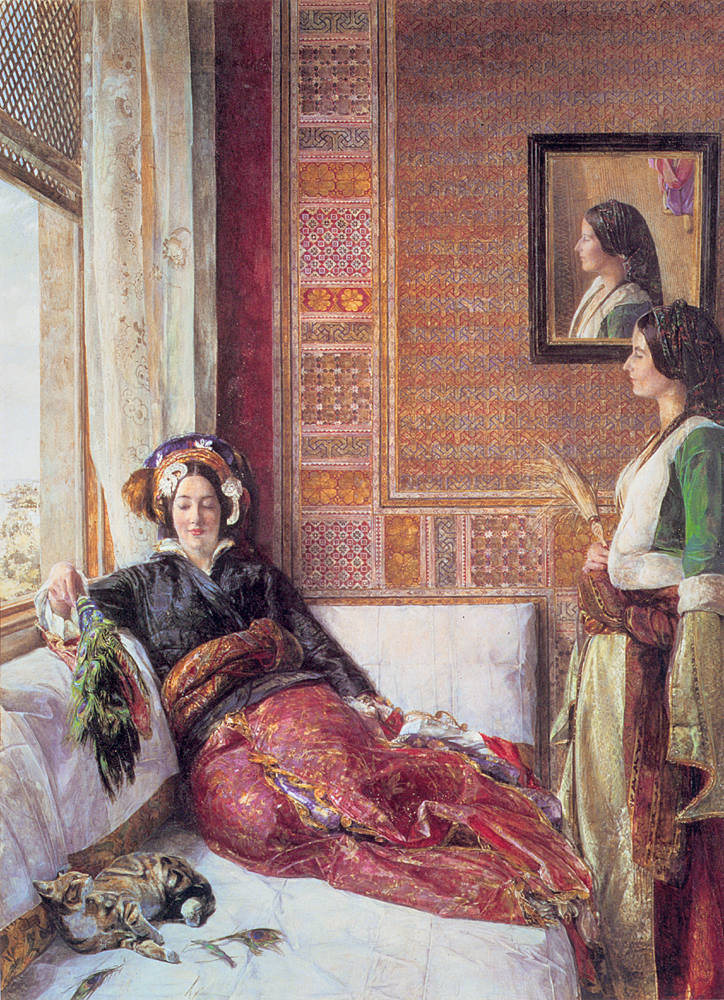
Just imagine the costume! Imagine the décor!

Lewis_JF_Harem_Life_in_Constantinople

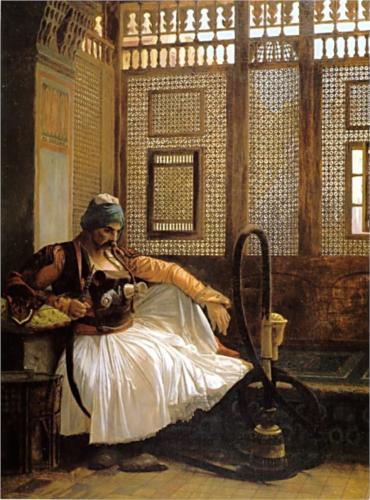
Ottoman civilisation may have been crumbling, politically, but it was in full flood in the creation of beautiful and unique aesthetic, and a particular way of life.

arnautm-smoking.jpg!Blog

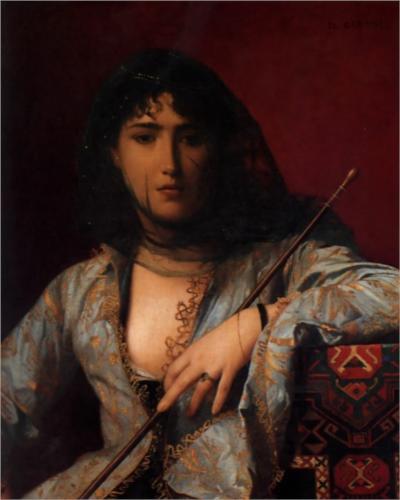
It would be gorgeous, wouldn’t it? And new: I’m rather tired of ballrooms, and chignons, and gowns. I want to see this veiled Circassian on the move:

 veiled-circassian-lady.jpg!Blog

So let’s forget the movie for the time being, and focus on the music.

Here’s an interpretation by Greg Burrows, a New York-based percussionist. He sent to to me the other day, inspired by Yashim’s adventures in The Bellini Card.

http://snd.sc/Yo1gsR

And here, if you haven’t heard them yet, are The Bookshop Band’s takes on An Evil Eye, the latest Yashim story.

http://www.youtube.com/watch?v=POrjLY3IHsA


Anyone with £100,000 to spare? (£5 million preferred)

Speaking of orientalists (see previous blog), Sotheby’s have a sale of Orientalist paintings on April 24th in London. The link is at the end of this post.

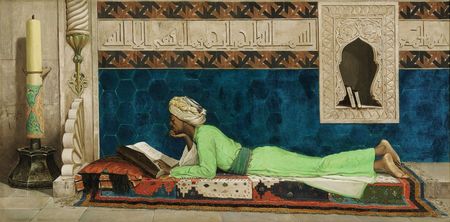
The star of the sale, to my mind, is Osman Hamdi Bey’s The Scholar: it could be Yashim’s young friend Kadri, from An Evil Eye, continuing his studies.

The estimate is £5 million.

If it’s too short notice to free up that amount, why not John Frederick Lewis’s A Halt in the Desert?

Lewis was not the first English artist to go East, but he was unusual in settling in Cairo for ten years from 1840, where he quietly worked on his sketch books. The British were about to fall in love with the Middle East. For one thing it was actually quite easy to go there by the 1840s, so that the sort of journeys which Byron had made so much of became almost everyday. David Wilkie, it’s true, didn’t make it home: his death aboard ship was commemorated in Turner’s Peace – Burial at Sea. Richard Dadd came home only to murder his own dad, afterwards pursuing his career inside Broadmoor; but others – like David Roberts – managed to lash themselves around the sites in short order. Even Edward Lear was able to roam from Albania to Petra (‘striped ham’, he noted) and get home safely. There is a good Lear in the sale, too. By the 1860s you could visit Palmyra with Thomas Cook.

Travellers by then could contrast the warmth and personality-based governance of the Ottomans with the repressive machinery of centralised government represented by Russia. After fighting the Ottomans in the cause of Greek independence, the British (and the French) tried to prop up the Sick Man by any possible means; British forces saw off an Egyptian incursion into the sultan’s dominions in 1840 (see An Evil Eye) and, famously, fought alongside the forces of the Sultan in the Crimea; some historians go so far as to describe the Ottoman Empire as a British protectorate in all but name. Echoing the spirit of Lady Mary Wortley Montagu’s observations in the previous century, some observers compared eastern freedoms favourably with the industrial slavery of Victorian England.

Lewis was not alone in trying to convey the dignity of Ottoman civilisation, partly by his emphasis on craftsmanship over soulless machine products (although by the 1840s, Europeans were unwittingly cooing over Manchester cottons on sale in the bazaars of Constantinople, fully in the belief that they had stumbled over a cache of exquisite native prints). There was a receptive audience for this stuff at home. Thackeray wrote: ‘There is a fortune to be made by painters in Cairo…I never saw such a variety of architecture, of life, of picturesqueness, of brilliant colour, of light and shade. There is a picture in every street, and at every bazaar stall.’ Lewis, whom he championed, really did it best: he may have recycled the same stuff for 25 years after he came home, even trying the patience of Ruskin, who had first encouraged him into oils, but he did it with a shy sense of irony.

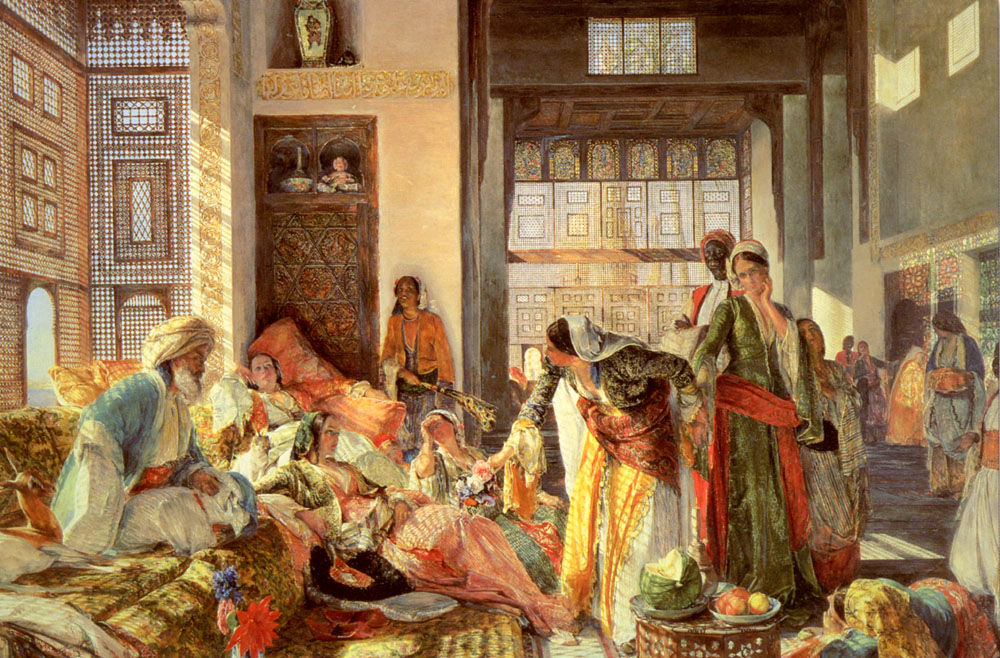
Both in The Carpet Seller and in Interior of a Mosque, Afternoon Prayer (The ‘Asr) he renders a disguised self-portrait, once as the carpet dealer, the other as an old military man about to pray, which seem to exude a private yearning for fellowship with a world he could, when all is said and done, only watch from the outside. I like this one, A Harem Scene, Cairo, for the detail:

Lewis and his wife had no children. They never went out to parties, he wrote very few letters, and after all the apparent excitement of Cairene life he seems to have lived a life of quiet and blameless activity with his brushes in Walton-on-Thames, part of which, I am sure, can be glimpsed out of the window of his harem picture. His wife modelled for some of the decorous odalisques. Called upon to speak after dinner at a gathering of watercolourists, he apparently gazed silently at the ceiling and then sat down.

Not many painters do so well.

http://www.sothebys.com/en/catalogues/ecatalogue.html/2012/the-orientalist-sale#/r=/en/ecat.fhtml.L12100.html+r.m=/en/ecat.grid.L12100.html/0/15/lotnum/asc/?cmp=L12100_0412_2_ECATexample/

Emilia Plater revealed!

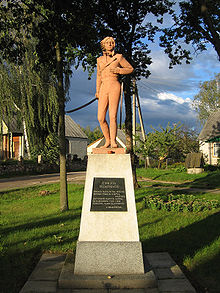
Well done everyone who guessed the identity of the Polish amazon: it was Countess Emilia Plater. Born in Lithuania, raised in modern-day Latvia, she died at Kapčiamiestis (Kopciowo) in Lithuania in 1831. This is her monument.

Her extraordinary and short life is well told on Wikipedia, here:

http://en.wikipedia.org/wiki/Emilia_Plater

The first right answer came from Canada, I believe – so congratulations to falcon44! And if they want their copy of An Evil Eye, I just need an address…

Another quiz soon!


Not Nancy Mitford

The dashing girl whose picture I posted yesterday has been identified as – among others –  Mulan, Maria Walewska (closer), Lady Hester Stanhope, Maria Lebstuck, the Contessa d’Aspi d’Istria (from The Bellini Card), Juana Galan, Lady Chatterton and the young Nancy Mitford.

No. She ain’t any one of them. And the only person who got it right so far is my sister Tabitha, who just knows a lot – but she can’t have the prize copy of An Evil Eye because she’s got one already and anyway family members are debarred from winning, as it says on the cornflake packets.

But here’s a clue or two: Stanislaw Palewski would have both known and admired her, and mourned her passing in 1831 at the tender age of 25.

Here she is, doing her thing the year she died. And that really is a clue.

Another portrait – and a quiz

One of the joys of writing historical novels, crime or otherwise, is discovering real-life characters and making them part of the story.

I’ve recently become devoted to this young lady. Note the sword, and the fly-away hair – and just begin to guess her life history!


To tell the truth, it all ends rather sadly, especially for Ambassador Palewski, Yashim’s old friend. That’s a clue by the way.

Any ideas? Email me secretly at [email protected] and a copy of An Evil Eye to the first right answer: who is she?

Quiz competition

The US edition of An Evil Eye, the latest Yashim adventure, comes out in paperback on February 28th. To mark the event, the first person to get the right answers to three questions wins two signed copies of An Evil Eye – one for them and one, maybe, for a friend! Everyone’s welcome to have a go, wherever they are in the world.

The questions are:

1. The Valide Sultan, the sultan’s mother and Yashim’s old friend, was born and raised a long way from the Topkapi Palace in Istanbul. Question is – where?

2. Stanislaw Palewski, the Polish ambassador, is lucky enough to have an adoring – and resourceful – housekeeper. What is her name?

3. And finally, Yashim cooks plenty of meals in the course of his investigations. Dishes like stuffed mussels, or tiny eggplants filled with spiced lamb, or vine leaves wrapped around aromatic rice, can be eaten as snacks, or meze, and have a generic name which indicates that they are stuffed. What are they called?

Just type your answers in the reply box below, and hit ‘Post Comment’. The winner will be chosen on March 1st.

Good luck!

Yashim’s Kitchen III

I don’t know if you’re having turkey this year? Or a goose? We are going for guinea fowl because they are so tasty, with a duck for the crisp skin. I quite like turkey but it makes a greasy stock, and a good stock is what you want for this pilaf.

Mehmet the Conqueror’s Grand Vizier used to serve this as a working lunch in divan, the council meeting held on a Friday. Into it he tossed a gold chickpea for some lucky pasha to discover (or break a tooth on): the Ottoman version of putting a sixpence in the Christmas pudding, perhaps.


Ingredients:

Basmati rice

Chickpeas, soaked overnight and boiled for an hour (but tinned chickpeas are pretty handy, too)

An onion

butter, salt, festive stock


Rinse the rice in cold water until the water is clear – this is to remove the starch, which would make the rice too sticky. Leave it to soak while you melt the onions in butter. When they are soft, add the chickpeas.

Drain the rice, stir it into the pan and add enough stock to cover the rice and a little more.

When the stock has all been absorbed, check the rice; it should be a little nutty, but almost edible. If necessary add a little more stock until the rice is almost done.

Now comes the strange pilaf magic: cover the pan with a cloth and a lid. Over a whisper of heat, or none, let the rice steam for fifteen minutes.

Turn the rice out into a dish, helping to fluff it out with a fork.

This rice method sounds like complicated alchemy, but it’s simple really – and it works.


Yashim’s Kitchen – stuffed mackerel

With some trepidation I prepared this rather spectacular dish in front of sixty people at a literary festival one Summer. It was a complete triumph, as you can see from my expression in the photo.

 Yashim cooks this, too, in An Evil Eye.

Ingredients:

A large fresh mackerel, not gutted

Olive oil

For the stuffing: A few shallots, scoop of pine nuts, scoop of chopped blanched almonds, scoop of chopped walnuts, a handful of currants soaked in warm water, a few dried apricots finely chopped, and some herbs and spices – generous pinches of cinnamon, allspice, ground cloves, kirmiz biber or chilli powder, sugar and dill and parsley, finely chopped.

Cooking is easy – it’s getting there that’s the challenge. You have to make a small incision beneath the gills, and then draw out the guts, and chuck them away. Lay the mackerel on a board and beat it with a rolling pin, or an empty bottle, making sure you’ve snapped the backbone. Massage the skin gently, to loosen it from the flesh and finally – this is the bit that makes your audience, if you have one, groan out loud – squeeze the whole thing out through the incision below the gills!

It is not easy. Go gently, trying not to tear the skin, as if you were squeezing a tube of toothpaste. You are left with an empty skin, still attached to the head. Rinse it out, making sure to remove any little bones, and set it aside.

Now make the stuffing: sweat the chopped shallots in oil, add all the nuts, and let them colour. Add all the other ingredients except the herbs, and stir them around.

Pick out as much of the flesh as you can from the bones, and mix it into the stuffing, with herbs, a squeeze of lemon, and salt and pepper to taste.

Cook it through for another couple of minutes. Let it cool a bit, and stuff that mackerel! Use a teaspoon, and gradually fill the skin, squeezing the stuffing right down to the end. It looks like a mackerel again.

You can roll the fish in flour and fry it, or better still brush with oil and set it under the grill, hot, until the skin begins to blister.

Finally, with a very sharp knife, slice the mackerel thickly, lay it on a plate like a fish, and serve with lemon wedges.

Housekeeping and apologies

Shortly before the British launch of An Evil Eye, a greedy web-hosting company in Melbourne made off with my website. Largely on principle (and partly because they asked for money, and I’d lost all my original set-up passwords, user names and such), I have walked away from it, with my nose in the air.

I’m about to start another at www.jasongoodwin.info. My children assure me that the dot-info tag is very low, but there’s someone else who has .com and frankly, .info describes exactly what I want. Plus it’s delightfully cheap.

Meantime, apologies to anyone searching elsewhere on the web. Come back later!

I’ve had some great feedback for An Evil Eye already, both in the States and in the UK, and I was chuffed that the Christian Science Monitor chose The Janissary Tree and its sequels as one of its favourite foreign detective series…

http://www.csmonitor.com/Books/2011/0701/Top-7-detective-series-set-in-foreign-locales/Yashim-the-Eunuch-series-by-Jason-Goodwin

And here is Marco Ventura’s delicious cover, for Faber in the UK.