Tag Archives: The Baklava Club

Yashim’s Istanbul Cook Book – latest!

Earlier this year, many of you generously volunteered to test a recipe for Yashim’s Istanbul Cook Book. All over the world, from Albania to Alabama, readers tried out some of Yashim’s favourite Ottoman dishes, and came back with really helpful – and mostly enthusiastic – comments.

I had intended to publish the cook book myself, and I boldly declared that it would be out this Summer, in time for Yashim’s last outing in The Baklava Club, the fifth of his Istanbul adventures.

It’s not. The Baklava Club is out – here in the US

The gorgeous US edition

The gorgeous US edition

And here in the UK and elsewhere…

The UK/Commonwealth edition

The UK/Commonwealth edition

…but Yashim’s Istanbul Cook Book is still on the stocks, waiting for suitably beautiful illustrations. Full colour printing is nowadays so cheap, and accessible, that it would be a shame to allow this opportunity for gorgeously illustrating Yashim’s world to slip by. So I’m using food photos, of course, but also some street shots, and wonderful old engravings and illustrations, to make the book doubly delicious.

Sweet Waters of Asia
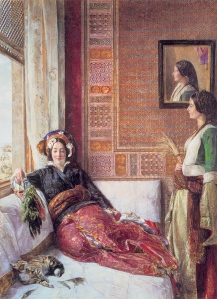
Sweet Waters of Asia

Lewis_JF_Harem_Life_in_Constantinople

hb_68.66

Thank you for your patience: I’ll let you know as soon as the proofs are done, and the book is ready for publication.

In the meantime, do follow @jsn_goodwin on Twitter, and Jason Goodwin, author, on Facebook, for more recipes, food and travel ideas, and Ottoman paraphernalia…

sp0081-Scene-from-above-new-palace-l

Finally, for those of you on Kindle, The Janissary Tree is on special offer right now, at 99p/$1.49. Please let your friends know,  if you think they might enjoy the series: it’s an easy way in.
Who’s Who in Yashim’s Istanbul

We must begin with the sleuth himself, of course. Yashim is as old as the 19th century, thirty six years old when he makes his first appearance in The Janissary Tree. He is the sultan’s confidential agent, or tebdil khasseky, in succession to Fevzi Ahmed – of whom much more in An Evil Eye (Yashim No. 4). Unlike Fevzi Ahmed, Yashim can visit anywhere and talk to anyone in Istanbul… for Yashim is a eunuch. Although he can make love, he will never father children.

You want to know how that works? Then you need to read Yashim No. 5, The Baklava Club. I’m afraid that’s all the explanation I can give you here.

I don’t want to press the eunuch theme (which makes some men cross their legs), but it is a metaphor for Yashim’s role as a sleuth. All through history, eunuchs were created to serve in the palace bureaucracy – it’s true for imperial China, and ancient Persia, as for the Byzantines and their successors, the Ottomans. Without family, their interests were allied with the ruler’s own ambitions and desires, making them men a ruler could safely trust.

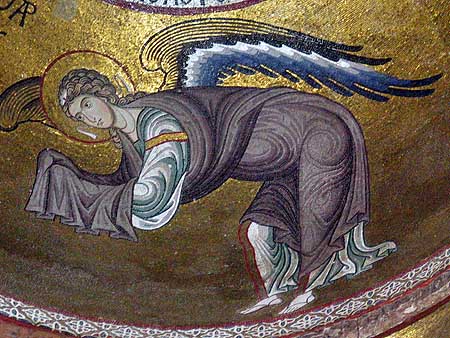
The Byzantines are thought to have modelled their representations of angels on eunuchs: chaste, and intercessionary, passing between the divine and the sublunary world. Above all, their role is to serve.

Angel from a mosaic in La Matorana, a Byzantine church in Palermo

Angel from a mosaic in La Matorana, a Byzantine church in Palermo

So Yashim, too, serves his sultan, and the people, and the requirements of justice.

He is also a fabulous cook, preparing the Thursday night dinner for his old friend Count Palewski, Polish ambassador to the Porte, as the Ottoman court was called. He draws on the full repetoire of Ottoman Turkish dishes, many of them first elucidated in the kitchens of Topkapi Palace, where Yashim was trained. It’s this palace tradition that allows Turkish cookery to be ranked as one of the three great classical cuisines of the world. The other two are French and Chinese.

Chimneys of the kitchens at Topkapi

Chimneys of the kitchens at Topkapi

Turkish buns

Turkish buns

Yashim has been well-trained. He has worked in the palace, and out of it, for a Greek merchant. He speaks many languages, and reads voraciously – French novels are a favourite, passed to him by the Valide, the Queen Mother, of whom more in a subsequent post!

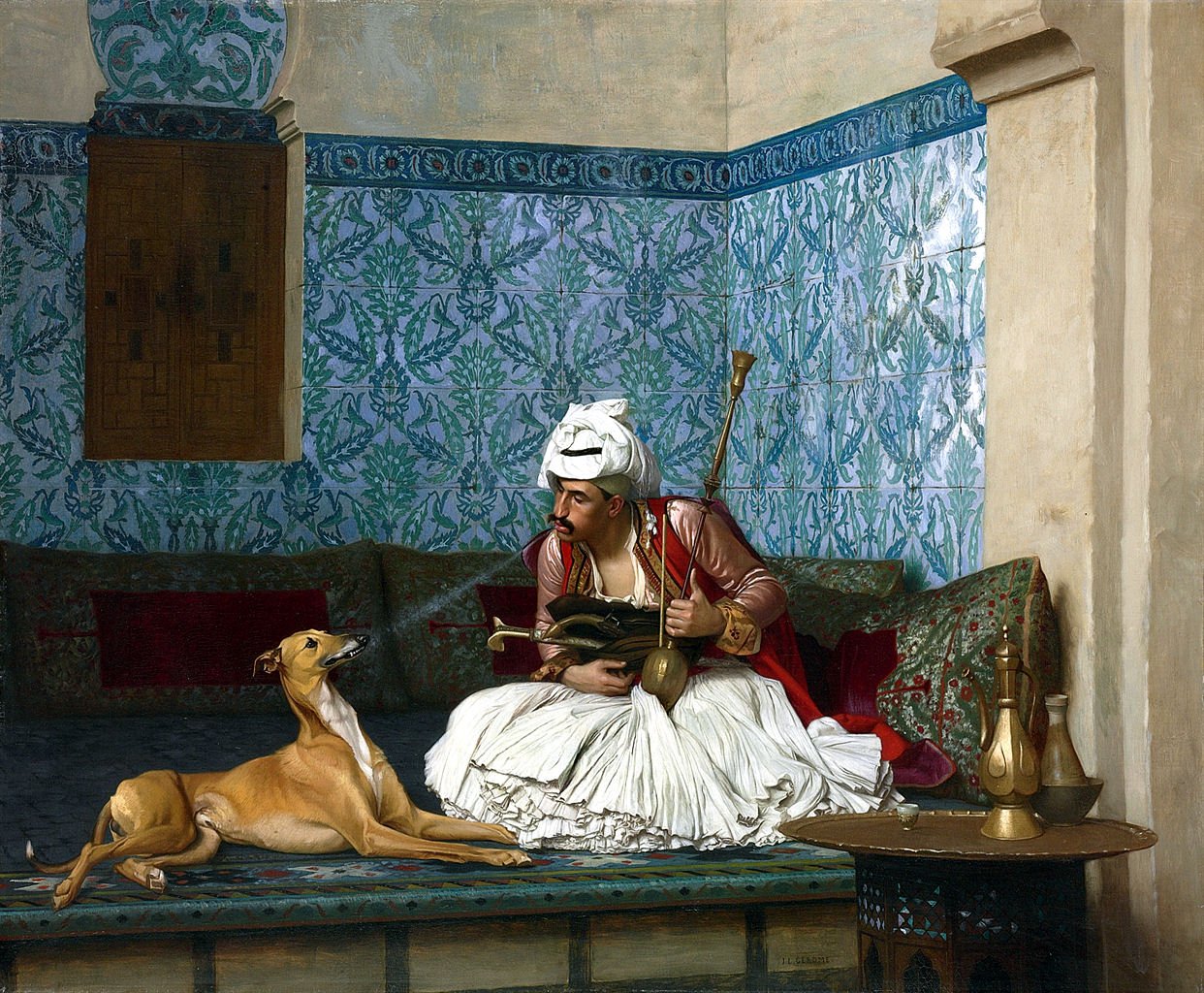
Jean Leon Gerome's finest work - Arnaut and his dog.

Jean Leon Gerome’s finest work – Arnaut and his dog.

Five things you should know about The Baklava Club

  1. THE BAKLAVA CLUB is out on June 5th in the US and UK – and in Estonia on June 1st! It’s set in 1842, six years into our acquaintance with Yashim, who made his first appearance in The Janissary Tree, set in 1836. That’s basically one adventure a year.     Baklava_Conference

The story involves a bunch of young Italian revolutionaries exiled in Istanbul, who see the Pope as their enemy, the enemy of liberal nationalism. Gregory XVI came to the papal throne in 1831, and was a diehard reactionary, determined to resist the spread of modern ideas and democracy – he even took a stand against railways. And of course he wasn’t just the Pope, Vicar of Christ: in those days, he ruled over the extensive Papal States, too. He stood in the way of reform, and a united Italy.

Pope Gregory XVI

Pope Gregory XVI

  1. It contains a delectable Ottoman picnic.

    Sweet Waters of Asia

    Sweet Waters of Asia

  2. Yashim falls in love.
  3. By the early 1840s, much of Europe was controlled by autocrats, including Czar Nicholas of Russia and the Austrian emperor Ferdinand. Growing popular resentment broke out in the liberal revolutions that swept Europe in 1848.

    1848 Revolution in Berlin

    1848 Revolution in Berlin

  4. One of the characters is inspired by a minor character in Raymond Chandler’s The Lady in the Lake. And I’ll send a US or UK hardback copy of The Baklava Club to the first person to name them both!
The gorgeous US edition

The gorgeous US edition


The Victorian iPhone and Other Traps for Writers

Looking through an album of old photographs the other day we came across this entertaining Victorian group.

Summer tea in a Devon garden in the 1880s: photographed by Beatrice, Countess of Durham.

Summer tea in a Devon garden in the 1880s: photographed by Beatrice, Countess of Durham. 

Effie, on the right, has either just lost at racquets or merely resents her sister Mary’s engagement to Captain Pilkington (together, back left). Mrs Bulteel, the photographer’s mother, isn’t too sure of Captain Pilkington herself; either that, or she flatters herself she looks best in profile. At the centre of the group sits Bessie, powerful and relaxed, wearing a floppy hat.

Look more closely. Unfazed by the towering emotions playing out around her, Bessie seems to be chatting to someone on her mobile phone.

Nothing breaks the mood like a duff note – a glaring anachronism, a remark made in inappropriate slang, or the moment when a character’s eyes change mysteriously from blue to brown. On the other hand, it’s important not to get too bogged down in verifying details when you’re writing. After all, it’s the story that counts, isn’t it?

Copy editing – which we’re doing now with The Baklava Club, Yashim’s fifth Istanbul adventure – is the time to address those niggles. Is the name of the street spelled correctly? Do baby artichokes really come into market before the asparagus? And the guns – are they alright?

A fowling piece by the celebrated French gun-maker, Nicholas-Noël Boutet (1761-1833). It was allegedly plundered from the baggage train of Joseph Buonaparte, King of Spain, following Wellington’s victory and rout of the French during the Peninsular War at Vittoria on 21 June 1813.

A fowling piece by the celebrated French gun-maker, Nicholas-Noël Boutet (1761-1833). It was allegedly plundered from the baggage train of Joseph Buonaparte, King of Spain, following Wellington’s victory and rout of the French during the Peninsular War at Vittoria on 21 June 1813.


The guns in question are a pair of fowling pieces belonging to Count Palewski, Polish ambassador in Istanbul, and Yashim’s friend. They were made in the early years of the nineteenth century by the Parisian gunsmith Boutet: exceptionally light and very beautiful. For this, and related detail, I consulted the Royal Armouries Museum, and my thanks are due to Mark Murray-Flutter who not only provided me with gunnery jargon but ultimately re-wrote a few sentences of The Baklava Club himself.