Tag Archives: Bosphorus

Gliding down the Bosphorus

I’m often asked to name my favourite place in Istanbul.

A bollard on the quay

A bollard on the quay


It isn’t a place, at all: it’s a passage, or a vantage point, or an adventure, with deep dark waters under the keel, and spray at the prow, and a briny bench – and a glass of tea.

It’s a trip on the Bosphorus.
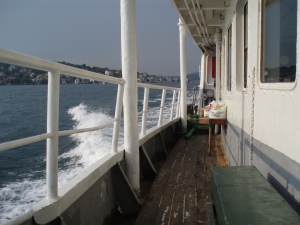
My favourite vantage point

My favourite vantage point

About  fourteen miles long, and sometimes no more than half a mile wide, this twisting strait divides Asia from Europe, and links the Black Sea to the Mediterranean. The name means the same as Oxford: where the cattle cross, from the legend of Io, transformed into a cow until she crossed the strait and regained her human form.
OLYMPUS DIGITAL CAMERA

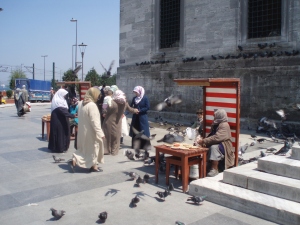
feeding the birds at Eminonu

There are all sorts of Bosphorus trips on offer, but I think it best explored on the ferries which morning and evening crowd around the ferry station at Eminonu. The slow vapur have high prows for punching through the seas which run in from the Sea of Marmara, and low thwarts for easy embarkation.

OLYMPUS DIGITAL CAMERA

ferry at a stage

Their bright green hawsers are casually coiled on the planking.

OLYMPUS DIGITAL CAMERA

on board at night

One day they’ll no doubt be replaced by fibreglass catamarans and a sensory world will disappear, composed of wet planks, splintered pilings, the bubble of thick paint on rust, and the old ferryboat smell which is the same the world over, a tincture of diesel oil, damp wood and the sour reek of air trapped in the cabins.
OLYMPUS DIGITAL CAMERA

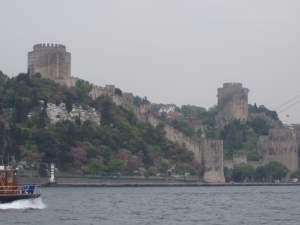
Rumeli Hisar

Meanwhile, buy a glass of tea at the counter and settle down on one of the outside benches that run along the bows; put your feet up on the rail, and watch the shores of the Bosphorus unscroll, like some Victorian panorama, their vistas of villas, palaces, restaurants and domes.

The galley of a Bosphorus ferry: I love the chopping boards!

The galley of a Bosphorus ferry: I love the chopping boards!

The last photo, above, shows where they make tea: a place I like so much I put it in Yashim’s new cookbook,  Yashim Cooks Istanbul. !
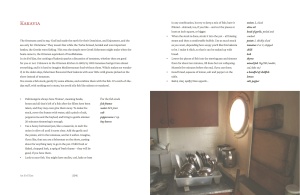
From Yashim Cooks Istanbul
From Yashim Cooks Istanbul

Tulipomania – (almost) too beautiful for words

A reader’s suggestion for putting tulips in the garden reminds me of this passage in my history of the Ottomans, Lords of the Horizons:

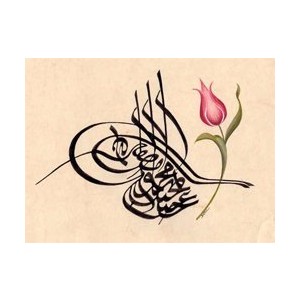
The tulip was the emblem of the Ottoman royal house, worked into textiles and inlay, and celebrated in poetry: the romantic tulip of Central Asia, that is, a lyre-shaped flower with pointed petals. For a brief period at the end of the seventeenth century the tulip’s sway in the Ottoman garden was challenged by melons and cucumbers; but under Ahmet III in the 1720s it came back into favour with a frenzy which recalled, in its less sordid aspects, the tulipomania of seventeenth-century Holland.

The Dutch mania had been a speculator’s bubble. In Turkey tulipomania came to symbolise the hedonism of the court. Sultan Ahmet III had so many children that with all the births, circumcisions and daughters’ weddings a permanent holiday atmosphere reigned in the Seraglio. ‘Let us laugh, let us play, let us enjoy the delights of the world to the full,’ wrote the court poet Nedim, a particular favourite of Sultan Ahmet’s. Grizzled old kapudan pashas stooped tenderly over the bulbs with little trowels; the head gardener laid his executioner’s tools aside, and dazzling were the nightly displays in the palace in the fleeting growing season. The French ambassador described such an evening at the house of Grand Vizier Damad Ibrahim Pasha in 1726:

When the tulips are in flower, and the Grand Vizier wishes to show them to the sultan, care is taken to fill the gaps where the tulips have come up blind, by flowers taken from other gardens and placed in bottles. Beside every fourth flower is stood a candle, level with the bloom, and along the alleys are hung cages filled with all kinds of birds. The trellises are all decorated with an enormous quantity of flowers of every sort, placed in bottles and lit by an infinite number of glass lamps of different colours. These lamps are also hung on the green branches of shrubs which are specially transplanted for the fete from neighbouring woods and placed behind the trellises. The effect of all these varied colours, and of the lights which are reflected by countless mirrors, is said to be magnificent. The illuminations, and the noisy consort of Turkish musical instruments which accompanies them, continue nightly so long as the tulips remain in flower, during which time the Grand Seigneur and his whole suite are lodged and fed at the expense of the Grand Vizier…

For ten years the whole of Constantinople gave itself over to illusions of fairyland. Giant turtles bearing flickering candelabra paddled through the Seraglio grounds. ‘Sometimes the court appears floating on the waters of the Bosphorus or the Golden Horn, in elegant caiques, covered with silken tents; sometimes it moves forward in a long cavalcade towards one or another of the pleasure palaces… These processions are made especially attractive by the beauty of the horses and the luxury of their caparisons; they progress, with golden or silver harnesses and plumed foreheads, their coverings resplendent with precious stones.’

At the back of it, though, lay policy desperate and inspired: it was all the handiwork of a single Grand Vizier, Damad Ibrahim Pasha, who feverishly worked the silken threads…

From Lords of the Horizons: A History of the Ottoman Empire