The historian Norman Davies has written a book after my own heart. Vanished Kingdoms details the stories of several significant European polities which no longer exist, including the Kingdoms, Duchies and Counties of Burgundy, the Polish-Lithianian Commonwealth, and Saxe-Coburg. The biggest recent Boojum is, of course, the Soviet Union, which vanished overnight without anyone – least of all Gorbachev – intending it to do so; nor the hundreds of thousands of soldiers, strategists, politicians or secret policemen devoted to its preservation, being able to do anything about it.
We tend to look at the history of existing things, rather than vanished ones; and the more eagerly when they are powerful existing things. And that brands us not only as creeps, but as fools: because the most interesting lessons of history, when you think about it, teach you how things fail and disappear.
My first published article was an essay on the Polish Government-in-Exile and the Estonian Consulate in London in the 1980s, both stubbornly defying the apparent verdict of history, which ruled that Poland was a communist satrap and Estonia a province. Happily it won me the Spectator/Telegraph Young Writer of the Year Award. Happier still, both the exiled government and the unconsular consulate – of a country which did not, officially, exist – were shortly to figure once again in their nations’ affairs.
I heartily recommend Vanished Kingdoms. And I offer my own contribution, in the prologue to my Ottoman history, Lords of the Horizons:
PROLOGUE
At the back of the Bayezit Mosque in Istanbul, close to the walls of the Grand Bazaar, stand the ruins of an old Byzantine chapel. Beneath its vaulted roof is a tumbledown cafe. Horn lanterns hanging from the wall cast a dim light on the clientele, while the open door affords a glimpse – beyond the gigantic cypress which grows in the courtyard of the Bayezit Mosque, past the porphyry columns – into the sanctuary of the mosque itself, where the faithful kneel in prayer.
In the cafe a little orchestra – flute, two drums, a viola and a triangle – is playing in one corner; a backlit sheet is stretched across another. Armchairs are taken by several elderly pashas, some in uniform, some in Stamboulines and fezzes, all of them supporting armfuls of grandchildren. Behind them sit a handful of solemn old men in turbans, smoking pipes; a clutch of Greek and Armenian women, swathed to invisibility in black shawls; and a couple of Cook’s tourists, in tweeds, hoping for an insight.

For in a moment Karagoz and Hacivat will skitter across the sheet, heroes of the shadow play, the Pantaloon and Harlequin of the Ottoman stage: jointed silhouettes, cut from dried camel leather, painted up and oiled for translucency. The original Karagoz, hunchbacked and foul-mouthed, and his straight man, Hacivat, are supposed to have developed their knockabout routines on a building site in 1396, where their antics proved so irresistible that work on Sultan Bayezit’s Great Mosque in Bursa ground to a halt, and the Sultan had them put to death. Others say Constantinople (Istanbul) always had its Karagoz and Hacivat, even in the days of the Roman emperors. Some think that the pair of them are offshoots of an ancient wisdom, dressed in a corrupted version of the licensed finery of the Sufi and the shaman and the bard.
In the semi-ruinous cafe they are worked by an Armenian, who is a mimic and comedian rolled up in a newspaper – a five-, six-, even seven-tasselled puppeteer. His is a very old, wandering profession. Over the years he has been in Hungary, setting garrisons in a roar, or in Egypt, raising a pasha’s smile; he has carried his cut-outs, lamp and little screen to Iraq and the Crimea; to the neighbourhood of Venice in the army’s van, and with the fleets to Algiers. The Cook’s tourists have been told to watch for his scurrilous take-off of a foreigner speaking Turkish. The orchestra wails and squeaks; the Armenian ladies giggle; the children squirm; and a constant supply of coffee cups moves about the room, borne by Circassian youths in ‘the good old costume’: which is baggy trousers, waistcoats, and coils of coloured linen piled on their shaven heads.
*
This book is about a people who do not exist. The word ‘Ottoman’ does not describe a place. Nobody nowadays speaks their language. Only a few professors can begin to understand their poetry – ‘We have no classics,’ snapped a Turkish poet in 1964 at a poetry symposium in Sofia, when asked to acquaint the group with examples of classical Ottoman verse.
For six hundred years the Ottoman Empire swelled and declined. It advanced from a dusty beylik in the foothills of Anatolia at the start of the fourteenth century to conquer the relics and successors of Byzantium,
including the entire Balkan peninsula from the Adriatic to the Black Sea, Greece, Serbia, Bulgaria, and the so-called Principalities of Wallachia and Moldavia north of the Danube. It took Anatolia. The submission of the Crimean Tartars in the fifteenth century, along with the capture of Constantinople in 1453, completed its control of the Black Sea. In 1517 it swept up the heartlands of Islam – Syria, Arabia, and Egypt, along with the Holy Cities of Mecca and Medina. Controlling the thoroughfares which linked Europe to the Middle East, the Ottoman Empire stretched from the Danube to the Nile.
The empire in those years was Islamic, martial, civilised and tolerant. To those who lived outside its boundaries, in lands known, by Islamic custom, as Dar ul-Harb, ‘Abode of War’, it was an irritant and a terror. To its own subject peoples, however, it belonged in the Dar ul-Islam, or ‘Abode of Peace’, and was such a prodigy of pep, so vigorous and so well-ordered, such a miracle of human ingenuity, that contemporaries felt it was helped into being by powers not quite human – diabolical or divine, depending on their point of view.
But at the start of the seventeenth century the Ottomans faltered. The Mediterranean Sea was relegated to second-division status, the Islamic spirit seemed to stagnate. The nations of the West were querulous and disunited, but their very squabbles proved vigorous and progressive. In the Ottoman, Islamic world the battles were already won, the arguments suppressed; the law was written, and the Ottomans cleaved ever more rigidly to the past in a spirit of narcissistic pride.
For the next three hundred years, the empire defied prognostications of its imminent collapse. Fractious and ramshackle, its politics riddled with corruption, its purposes furred by sloth, it was a miracle of a kind, too, a prodigy of decay. ‘It has become like an old body, crazed through with many vices, which remain when the youth and strength is decayed,’ wrote Sir Thomas Roe in 1621. The crazed old body survived him by almost three centuries; outlived its fiercest enemies, the Russian Tsar, and the Habsburg Emperor, by a full four years. Not until 1878 were the Ottomans dislodged from Bosnia; not until 1882 did the Sultan cease to rule, in title anyway, over Egypt. Albania, on the Adriatic coast, was one of the toughest provinces the Ottomans ever sought to subdue in the fifteenth century; but the Albanians were still sending parliamentary deputies to Constantinople in 1909.
This was an Islamic empire, though many of its subjects were not Muslim, and it made no effort to convert them. It controlled the thoroughfares between East and West, but it was not very interested in trade. It was, by common consent, a Turkish empire, but most of its dignitaries and officers, and its shock troops, too, were Balkan Slavs. Its ceremonial was Byzantine, its dignity Persian, its wealth Egyptian, its letters Arabic. The Ottomans were not accounted builders by contemporaries – even though one grim old Grand Vizier was remembered as the man who built more churches than Justinian. They came with no schemes of agricultural improvement, although production soared in the lands they conquered in Europe. They were not religious fanatics as a rule; Sunni Muslims, they followed the moderate Hanefi school of Koranic interpretation. Sultans read the life of Alexander, but they were not particularly interested in the past.[1] But the young Ivan the Terrible took the life of Mehmet the Conqueror as his primer, and the Venetians, who always liked to know the way things ran, fiercely admired the system of government which Mehmet had devised, and found in it a Palladian quality, of harmony and handsome proportion.
The empire outlived its grandeur, famously. By the time Napoleon landed in Egypt the empire seemed to the world as weak as Spain, as decayed in ancient pomp as Venice. Rich in talents still, the empire no longer provided a glittering stage for their expression. Its most brilliant sailors were all Greek. Its canniest merchants were Armenian. Its soldiers were ineptly led, while everywhere admired for their courage. Imperial statesmen operated at home in an atmosphere of intolerable suspicion. Yet the empire lingered into the twentieth century with no white cliffs to shield it, like England; no single language to unite it, like France. Unlike Spain, the empire was wedded to no illusions of religious purity; and it never discovered gold, or Atlantic trade, or steam. The Ottomans seemed to stand, in their final years, for negotiation over decision, for tradition over innovation, and for a dry understanding of the world’s ways over all that was thrusting and progressive about the western world.
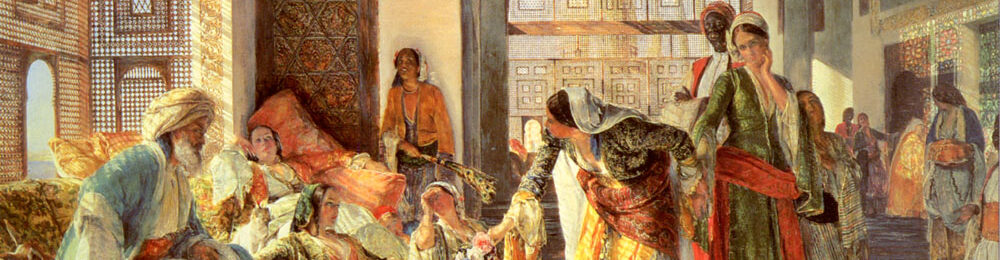
Never, perhaps, did a power fall so low, in such a glare of publicity – the Crimean War of 1856, in which Turkey fought Russia with French and British aid, was the first war in history covered by journalists. Tsar Alexander called the Ottoman Empire ‘the Sick Man of Europe’. The Victorians referred to it impersonally as ‘the Eastern Question’, to which an answer, by implication, was to be supplied by muscular Christian gentlemen. To many westerners, of course, what was no longer an object of fear became an object of curiosity, and even admiration: certainly no one could deny the beauty of a traditional society, and painters found a ready market for their depictions of Levantine life. In the nineteenth century the empire made a valiant attempt to remodel itself along western lines, to enjoy, as everyone hoped, some of the western magic; but the convulsion killed it, for by then the heart was weak.
*
Karagoz is put in a coffin and buried at the end of the play, but just before the light goes out he pushes up the lid, hops out and sits on the coffin, roaring with laughter. The Armenian puppeteer puts out his lamp. The little orchestra, after a timpanic crescendo, lay down their instruments. The Circassian boys who have been handing refreshments round now pass amongst the audience for coins, and the pashas’ little girls, who have giggled through some improper dialogue, wriggle out.
The grave old master behind all the moves and bustle of that prodigious performance known as the Ottoman Empire moves on, packs up his puppets, extinguishes his lamp, and leaves only the screen behind: the hills, plains and declivities of the Balkans, the plateaux and coasts of Anatolia, the Holy Cities Mecca and Medina, the sands of Egypt, the grasslands of Hungary, and the grey, grey waters of the Bosphorus, which slap at the pilings of the Galata bridge.