Category Archives: The writing life

Getting out

Recently Barbara Nadel and I did a really enjoyable talk at Daunt’s Bookshop in Marylebone High Street. Lots of good questions – I found myself enumerating the advantages of Yashim’s unusual condition and could hardly stop…

Afterwards we rolled into a restaurant across the road called – is it kismet? – Topkapi. And the next day I was in Istanbul again.

One I’m really looking forward to is this weekend’s Crime and Mystery Conference at St Hilda’s College, Oxford, where I’m talking on Sex and the Single Detective. I think it’s called giving a paper… so I need to do some serious thinking before Sunday. Are all detectives really eunuchs? Discuss. The indefatigable and generous Natasha Cooper is in the chair.

Closer to home, I’m going to be in Weymouth at the library on Wednesday 10th September. 7.30pm. I remember Weymouth as a Mecca for secondhand books so I’ll be arriving early. And on September 15th I’ll be in London for the SW11 Festival, talking about Yashim and The Bellini Card.

October is the monster convention for crime writers and readers, Bouchercon, (pron. Bow-chercon) in Baltimore. It’ll be my first time in that city. It’s the same month that The Snake Stone comes out in paperback in the US. More details later.

Later that month, too, I’ll be in Sheffield for the Off The Shelf Festival – the 22nd, I think.

Hope to meet some of you then!
Cities

If you want to know the time, ask a policeman. If you want to know what makes a city tick, ask a crime-writer.

That’s how NPR – America’s answer to Radio 4 – are taking listeners to fascinating places around the world.

I think it’s a brilliant idea. Crime-writers  do explore their cities. Sometimes they define them – imagine a London without Sherlock Holmes at 221b Baker Street, or Los Angeles without Philip Marlowe. For several minutes, at breakfast-time in the summer holidays, you might hear Donna Leon strolling through Venice,  Robert P. Parker talking about Boston, Laura Lippman on Baltimore. It’s called ‘Crime in the City’ and it airs on Morning Edition.

So last week, while in Istanbul again, I spent a great day tramping the streets with NPR journalist Ivan Watson, visiting places and people I know, linking them to passages from the books.

We went underground, into the cisterns of Byzantine Constantinople. We went onto rooftops, with Istanbul spread below us. I did one reading about muezzins to the sound of the muezzins – and another, about the Spice Bazaar, to the sound of hucksters and shoppers in the Spice Bazaar. We talked about Yashim, and Istanbul, and the passage of history – and at the end of the day we went to a friend’s place and actually cooked imam bayildi the way Yashim might have done it, with an indecent amount of virgin oil.

It tasted delicious.

The segment runs the week of August 11th.

Cadence: the authorial voice

Faber are about to release the first Yashim story, The Janissary Tree, as an audiobook – which makes this quite a Summer along with the paperback edition of The Snake Stone and The Bellini Card itself.

Today I got the discs – a sneak preview.

The reader is Andrew Sachs, and he is brilliant. His voice is precise, quiet, companionable. He carries the book, delivering drama in surges – and for speech he does more than create accents. He makes characters.

I’m fascinated by the way he can suggest a woman’s voice, while using his own.

And now, for the first time, Yashim speaks!

Wheels in Motion I

The Bellini Card is at the printers in the UK. A fortnight ago, bound proofs arrived – looking very stylish. The cover was actually a black-and-white version of the glorious Technicolor cover that Faber have designed, but it looked terrific – and a lot sexier than the old plain pale blue covers which bound proofs used to have. Either way, it’s always rather exciting to have your book as a book. It reads differently, and I don’t know exactly why.

I’ve been to plenty of houses which have no books. I’ve met people who chuck books after they’ve read them, or give them away. I write this, and over the rim of my screen I can see at least a thousand books stacked in shelves, in no especial order. I could take you next door and show you several thousands more.

Now and then, Kate and I go through some of the shelves with a burning urge to get rid of at least a few ill-natured books we don’t like, books we’ll never read, really stupid books.

We last singled out – four.

Singled them out, forgot, and now, I think, they’re back in the shelves, or in a pile somewhere on the floor.

The truth is that every book tells a story. Sometimes wittingly,  sometimes – well, it’s a cover. A period of history. A memory. Or a hope – that someday something is going to sneak up and surprise you.

In the last two weeks: a book of photographs of the Ypres Salient, in World War I: photos of then, and now. Carnage, mud, a blasted tree, dead horses. The same view, in the 1970s: one of those calm French avenues of trees, with a 2CV motoring carelessly past sown fields.

A novel by John Cooper Powys called Wolf Solent, which I took on the plane to Istanbul and back (and my sister’s name scribbled in the front – how did that get here?).

Julia Pardoe’s Beauties of the Bosphorus – a recent treasure. Wonderful engravings of 1830s Istanbul, which you can also view at: www.htl-steyr.ac.at/~holz/pardoe/text_plate/001misspa.html

And The Bellini Card, in bound proof, slipping out of a Jiffy bag.

Getting it wrong

The other day I wrote about the importance of getting it right. 


You’re also free, I think, to get it wrong – even in a historical novel. Different writers have different thresholds, of course, but even the strictest acknowledge that when it comes to fiction it’s the story that really counts. Joan Aiken wrote a terrific series of historical novels for children, set in an 18th century England where the House of Stuart still reigned: she got it wrong, but it felt absolutely right. What’s important is consistency.

In the Yashim stories I wouldn’t go that far. It is 1836, or 1840, and the sultan is the sultan. Venice is under Austrian occupation. You could buy champagne in Pera, on the shores of the Golden Horn. Gentile Bellini was, indeed, invited to Istanbul in 1479, where he painted a portrait of sultan Mehmed II. These, to me, are the Big Facts. There are lots more, and half the fun is weaving one’s imagination around them.

So one of my favourite characters is the validé, the sultan’s mother, whose astonishing story – from French ingénue to harem queen – is brilliantly recounted in Leslie Blanche’s The Wilder Shores of Love. She is Yashim’s friend in the palace. He appreciates her dry cynicism; she relishes his lurid tales from the City; and they share a fondness for Parisian novels.

But in truth, her presence in the harem is a matter of historical speculation, not certified fact, so no-one can say for sure whether she became the mother of Sultan Mahmud II. Either way, Mahmud’s mother was certainly dead by 1818: you can visit her tomb in Istanbul.

In The Bellini Card, set in 1840, she puts Yashim on the right track. She is very old; she is also very clever.

I wouldn’t lose her for the world. 

Getting It Right

Nothing breaks the mood like a duff note – a glaring anachronism, a remark made in inappropriate slang, or the moment when your character’s eyes change mysteriously from blue to brown.

On the other hand, it’s important not to get too bogged down in verifying details when you’re writing. After all, it’s the story that counts, isn’t it?

Copy editing – which we’re doing now with The Bellini Card – is the proper time to address those niggles.

Is the name of the street spelled correctly? Do baby artichokes come into market before the asparagus?

Last week I even asked a fencing master round for tea, and we discussed the swordplay I’d written for the Contessa. It has been years since I fenced – sabre, not foil – but it turned out I’d got it almost right, except for calling octave optime; and he had a nice riff for me about a beat to the blade

So The Bellini Card even has a fight co-ordinator!

On the question of slang,  I gave some minor characters in The Janissary Tree Cockney accents. I wanted to show that they were working men and women who’d grown up on the city streets: Istanbul, of course, not London. I think it was the right choice – I’m writing in English, after all. Decide for yourself, maybe.

I just checked with a friend whether women were able to work as calligraphers in the Ottoman Empire, transcribing the Koran.  

My answer arrived by email: a beautiful Hilya – a calligraphic portrayal of the Prophet – by an 18th century woman calligrapher,  Esma Ibret.

Judging a book by…its cover

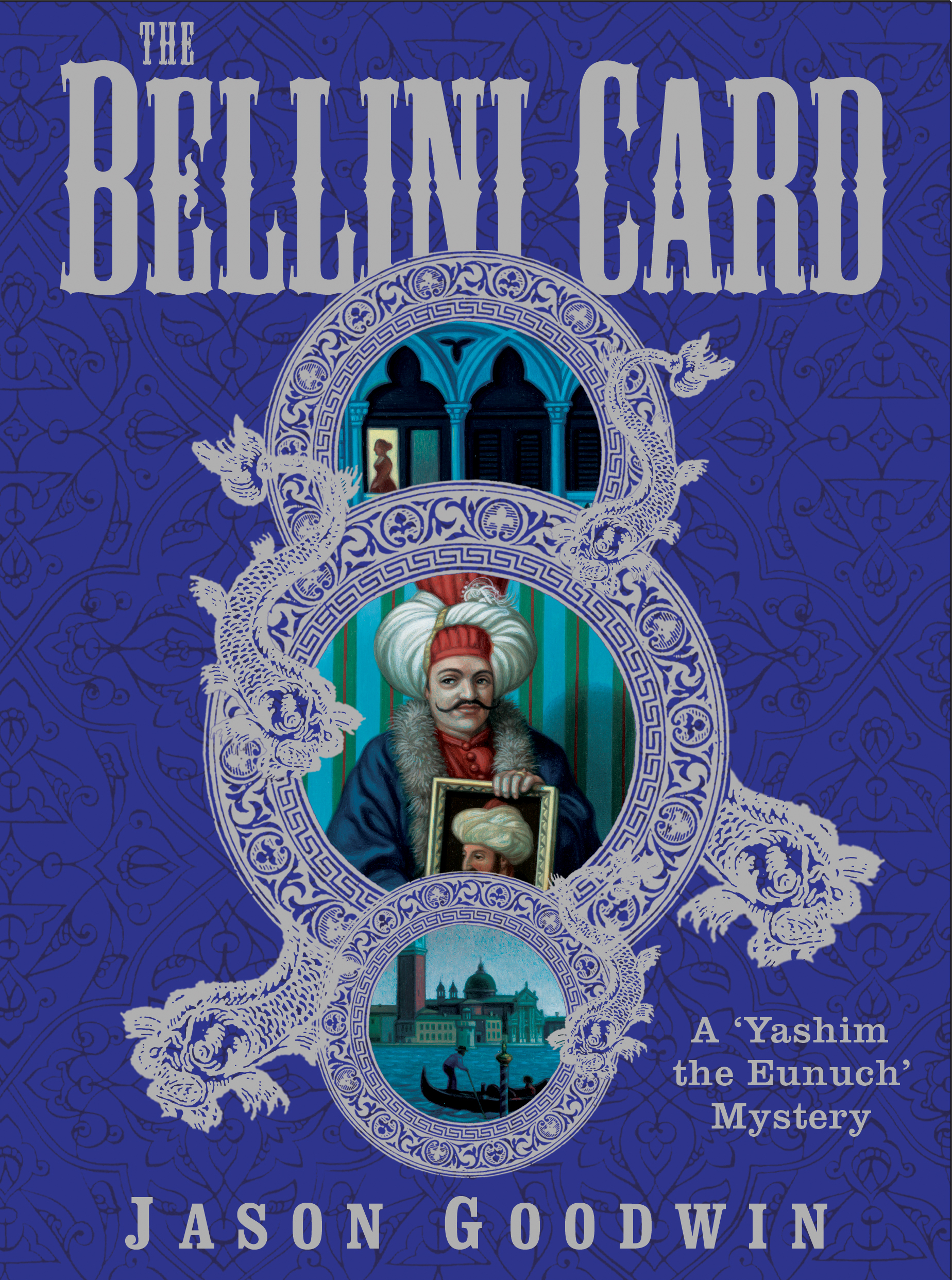
Faber’s artwork for the UK edition has popped up on my screen! I like it enormously, just as I liked the covers of the first two Yashim novels, The Janissary Tree and The Snake Stone. They manage to look period and fun at the same time: bold colours, strong motifs, and a striking family resemblance, too. I get the feeling that the designers enjoyed themselves here, don’t you? 

this fabulous Faber cover art

A silhouette in a lighted window. A gondola. And a man in an extravagant turban, clutching a painting. It’s as if clues are being dropped even before you open the book.


The End

Link here to www.jasongoodwin.net.

You know your book’s done when those two words appear at the bottom of the page.

Triumph – or disaster?

I can’t tell. Sometimes I think that finishing a book is the literary equivalent of a one-night stand: breakfast is yet to come. That’s when you get to see your work in proof – the whole book set in type, like a real book. That’s often when you realise if a section of dialogue is flat, a description jars the pace of the narrative, or the story is moving too fast.

That’s when you feel like a sculptor, too, working happily on clay. It’s still yours to shape.

In The Bellini Card Yashim’s old friend Palewski, Polish Ambassador to the Sublime Porte (the Ottoman Court) is sent to Venice to track down a lost painting of Mehmed II.

I examine the proofs and I wonder – does Yashim enter this story the way I want? It’s clear, on this printed page: yes, it works. It makes me smile.

Just a few others have read The Bellini Card. And they smiled, too.